Full Bus Wraps vs. Traditional Panels: Which Is Right for Your Brand?
When it comes to outdoor transit advertising, brands often debate between going for a full bus wrap and sticking to traditional panel advertising (side-panels, back-panels, partial wraps). Both formats have their merits — but depending on your campaign goals, budget, and target audience, the difference can significantly impact visibility, recall and ROI. In this post, we compare full bus wraps and traditional panels in detail, weigh their pros and cons, and show how businesses have leveraged each format successfully — especially in the context of India’s dynamic transit media landscape.
Understanding the Formats: What Is a Full Bus Wrap and What Are Traditional Panels?
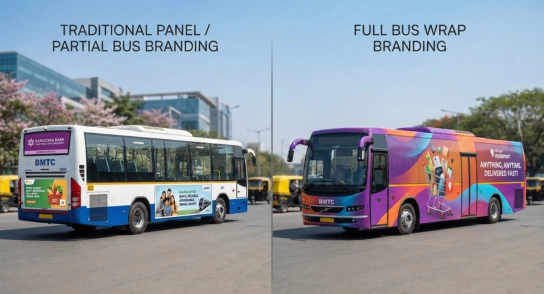
What is a Full Bus Wrap?
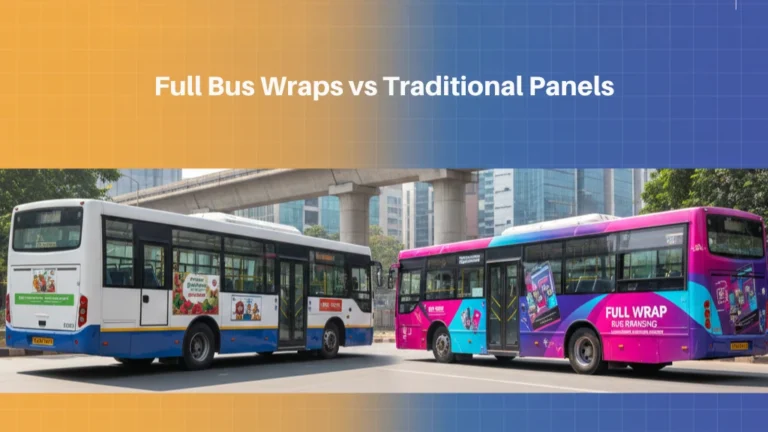
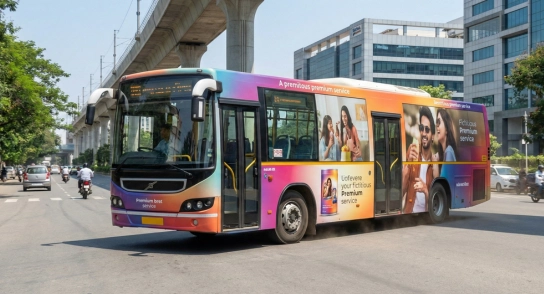
A full bus wrap is when the advertisement covers the entire exterior of the bus — front, back, sides — thereby turning the entire vehicle into a “moving billboard.”
Full wraps often make use of vinyl materials (sometimes with one-way vision films over windows) so that the design is continuous and visible, while still allowing passengers to see out.
What Are Traditional Panels / Partial Wraps / Side Panels?
Traditional panel-based bus advertising typically uses smaller, fixed ad spaces: side-panels, back-panels, partial wraps (only a portion of the bus’s body), or interior panels.
These formats are less extensive, covering only specific sections of the bus, often chosen for cost-effectiveness or targeted messaging.
Pros of Full Bus Wraps
- Maximum Visibility & High Impact
Because full bus wraps cover the entire bus exterior, they catch attention easily — whether someone is walking, driving, waiting at a signal, or commuting. The large format and continuous design make the brand nearly impossible to ignore. - Broad Reach — Route-Based, City-Wide Exposure
With buses constantly moving across busy routes — commercial districts, residential areas, malls, and transport hubs — a full wrap helps your brand reach a broad, mixed demographic: pedestrians, drivers, regular commuters.
This makes it especially effective in large metros like Bengaluru, where daily commuting population is high and urban density ensures many eyeballs. - Strong Brand Recall & Perception
Frequent exposure — as buses ply same or different routes daily — builds memory recall. When viewers repeatedly see the same striking visuals day after day, the brand becomes familiar and trusted.
Also, full wraps give a sense of scale and commitment; they often make a brand appear more established and “big,” which can improve brand perception. - Cost-Effective Compared to Static Advertising Alternatives
Compared to extensive campaigns like multiple billboards or frequent digital ad spends, a full wrap offers significant coverage at comparatively lower investment.
Because your ad spends many hours daily on the road and reaches varied demographics, the cost per thousand impressions (CPM) can be attractive, especially for brands aiming for city-wide visibility. - Creative Flexibility & Design Freedom
Full wraps let you use the entire surface of the bus — sides, windows, rear, front — enabling creative storytelling, bold visuals, and full-brand messaging. It’s not just a small billboard; it’s a canvas.
Pros of Traditional Panels
- Lower Cost — More Accessible for Smaller Campaigns
Traditional panels often cost less than full wraps. For businesses with limited budgets, partial wraps or side-panels provide a way to tap into transit media without heavy investment. - Route/Area-Specific Targeting
If you want to target a specific neighbourhood or demographic — for example college students near a campus or office-goers near tech parks — using buses that ply those routes, with side/back panels, can be a hyperlocal, efficient way to reach the right people. - Less Visual Clutter & Easier Maintenance
Because you are using smaller sections of the bus, the ad space is easier to manage, maintain, and update (if needed). Also, design is simpler, which may reduce design and installation time and cost. - Good for Short-Term or Test Campaigns
If your campaign is short-term (product launch, local event, promotion) and you want to test transit advertising without full commitment, partial panels provide flexibility.
Cons & Limitations: What You Lose / Risk — Full Wraps vs Panels
Challenges with Full Bus Wraps
- Higher Initial Cost: Full wraps require more materials, installation work, and design effort — which may not be ideal for small budgets.
- Route Dependence: While wide reach is a plus, if the chosen bus doesn’t travel through high-traffic or relevant zones, visibility may suffer.
- Overkill for Niche/Hyperlocal Audience: For very targeted, small-audience campaigns, full wraps may be overkill — side-panels or partial wraps may suffice.
- Creative Risk: Poor design on a full wrap can look cluttered or overwhelming, which can neglect brand clarity.
Challenges with Traditional Panels / Partial Wraps
- Limited Visibility: Since only a portion of the bus is used, ads may be less noticeable — especially in heavy traffic or at a distance.
- Lower Brand Recall: Smaller ads may not leave as lasting an impression as a full wrap. Frequency and repetition matter, and smaller panels may not achieve the same impact.
- Less “Wow” Factor: Side-panels often feel more like ordinary billboards — they don’t leverage the full “moving billboard” potential of a bus.
- Restricted Creativity: Limited space restricts the narrative and visual storytelling options.
When to Use What: Choosing Between Full Wrap or Panels
- When brand-wide visibility and maximum impact is needed (e.g. citywide brand launch, high-reach campaigns, new product awareness) → go for Full Bus Wrap.
- When the target audience is localized / neighbourhood-specific (e.g. local store, a campus event, region-specific offer) → Traditional Panels / Partial Wraps may be more cost-effective and efficient.
- Budget-limited campaigns — traditional panels or partial wraps help tap into transit media without heavy investment.
- Short-duration or test campaigns — go with panels to check initial traction before scaling up.
- Creative storytelling or brand positioning (premium, large-scale, lifestyle brands) — full wraps offer more canvas and flexibility.
Success Stories & Real-World Impact: Transit Advertising in India
Transit media is deeply rooted in Indian OOH advertising. According to a recent industry report, the share of transit ads in the Indian OOH market has grown from 25% to 33%.
- Urban & semi-urban reach: In mega-cities like Bengaluru, a full-body wrap on a bus (for instance a Volvo or BMTC bus) can drive tremendous visibility across residential, commercial, and industrial zones — a strategy many brands leveraged for city-wide launches.
- Hyperlocal targeting for SMEs: Smaller businesses or local shops have used partial panels on buses that ply within particular localities — effectively reaching target customers without overspending.
- Complement to digital & social campaigns: Many recent transit campaigns integrate QR codes, route mapping and modern media-tracking to combine the physical reach of transit ads with digital audience engagement — maximizing both brand recall and conversions.
At BrandOnWheelz, this diversity in formats — full wraps, partial wraps, metro branding, auto and cab branding — allows brands to tailor their transit media spend smartly across cities and audiences.
Full Bus Wraps vs Traditional Panels: Quick Comparison
Aspect | Full Bus Wrap | Traditional Panels / Partial Wraps |
Visibility & Impact | Maximum – whole bus acts like a billboard | Moderate – depends on panel size & placement |
Reach (Area Covered) | Very wide — across routes, neighborhoods, city zones | More localized / route-specific |
Brand Recall | Strong, due to size + frequency | Average to good (less immersive) |
Cost | Higher upfront | Lower upfront — more budget-friendly |
Creativity & Design Flexibility | High — full canvas, windows, rear, front | Limited — fixed panel area |
Best Use Cases | Brand launches, mass-market reach, high recall campaigns | Local promotions, small budgets, hyperlocal targeting |
Which Format Should You Choose for Maximum ROI?
If your goal is to create city-wide awareness, build brand presence, and make a strong visual impact, a full bus wrap is often the most powerful way to go — especially in large urban markets. On the other hand, if you want cost-efficiency, route-level targeting, or are running a short campaign, traditional panels / partial wraps can serve you well.
At BrandOnWheelz, we recommend evaluating your campaign objective, target audience, and budget first. Once these are clear, selecting the right transit media format becomes straightforward — and often, combining formats (e.g. full wraps + panel ads + auto branding) offers the best mix of reach and precision.
Frequently Asked Questions
1. What is full wrap bus branding?
Full wrap bus branding covers the entire bus exterior, turning it into a high-impact moving billboard with maximum visibility and brand recall.
2. How is traditional panel bus advertising different?
Traditional bus panels use limited ad spaces like side or back panels, offering lower cost but less visual impact than full wraps.
3. Which bus advertising format gives better brand visibility?
Full wrap bus branding delivers higher visibility and recall due to larger surface coverage and continuous exposure across city routes.
4. Is full bus wrap advertising cost-effective?
Yes, despite higher upfront cost, full wraps offer strong ROI through wide reach, repeated impressions, and long-term brand awareness.
5. When should brands choose traditional bus panels?
Traditional panels work best for local campaigns, short-term promotions, or brands with budget constraints seeking targeted exposure.